Studio, Workshop, Factory: Three Ways to Build AI Solutions
Should AI agents plan their own work, follow a skill, or operate within a defined workflow? The Studio, Workshop, and Factory framework helps teams choose, and shows why planned workflows and careful context management matter for recurring business work.
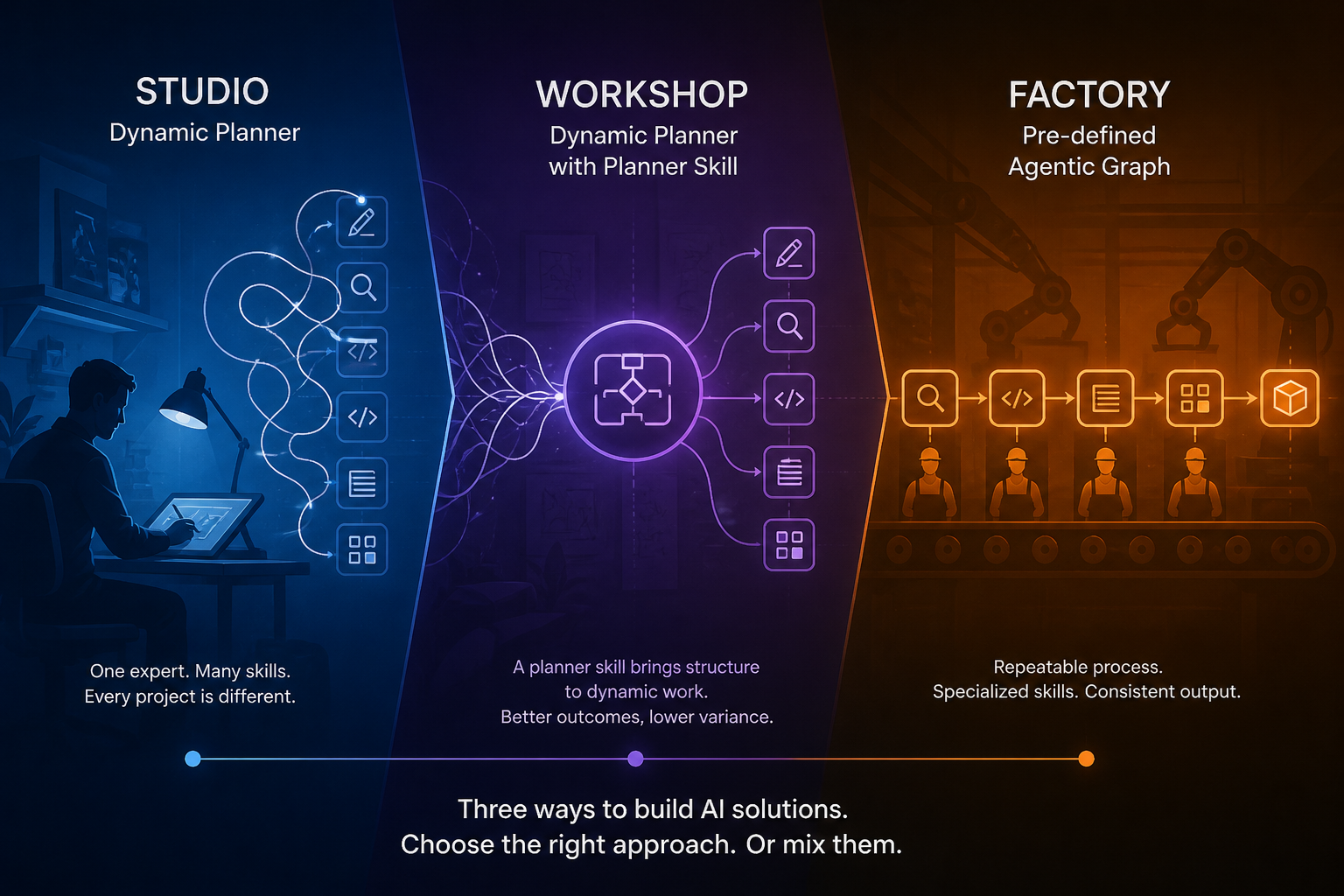
One of the most important decisions in an AI solution has little to do with which model you choose.
It is deciding who plans the work.
Should the model receive an objective and figure out the steps on its own? Should it follow a procedure supplied as a skill? Or should the process be designed in advance, with agents responsible for particular steps?
At AnyQuest, we support all three approaches. Each has its place. But for recurring business work, I believe planned workflows and deliberate context management deserve more attention than they often get.
I find it useful to think of the three approaches as the Studio, the Workshop, and the Factory.
The Studio: Give the agent a goal
In a studio, an artisan takes on a project, decides how to approach it, uses the tools at hand, and adjusts as the work progresses. Each project can be different.
A dynamic AI planner works much the same way. Give it an objective and access to tools, and it decides what to do next. It observes the result, revises its plan, and continues.
Claude Code is an example of this style. It can explore an unfamiliar codebase, form a hypothesis, make a change, run tests, and decide what to try next. The developer does not need to specify every step in advance.
The Studio is a good fit for exploratory work: investigating an unfamiliar company, researching an open-ended question, or debugging a problem that has not been seen before. It is especially attractive when the work is infrequent and a person is available to review the result.
The trade-off is variability. The agent may take different paths on similar tasks, miss a step, follow a dead end, or stop before the work is complete. Cost and latency can vary with the length of the investigation.
That does not make dynamic planning a bad approach. It means we should use it where its flexibility is valuable—and add controls where the consequences of an error require them.
The Workshop: Give the agent a process
Now suppose the work is recurring. We know something about how to do it, but each case still requires adaptation.
We can give the planner a skill: a reusable set of instructions describing the process, the tools to use, and what a good result should look like.
This is the Workshop. The agent still has room to decide how to carry out the work, but it starts with an established method rather than inventing one from scratch.
For example, a research skill might tell an agent which sources to consult, which questions to answer, and how to document evidence. A code-review skill might specify checks for correctness, security, performance, and test coverage.
A skill can reduce planning variance and make expertise reusable. It is also relatively easy to update as the team learns.
But there is a distinction between describing a process and enforcing one. The agent must still interpret and follow the instructions. It may skip or merge steps, and the degree of adherence depends on the model, the task, and the context it receives.
We can strengthen the Workshop with validators, required artifacts, focused subagents, approval tools, and other controls. In some cases, that is all the structure the job needs.
The Factory: Build the process into the system
In a factory, the process is designed in advance. Work moves through defined stages, with explicit hand-offs and checks.
The AI equivalent is a pre-defined agentic graph. A developer or domain expert decomposes a recurring job into steps, defines how they connect, and specifies what each step receives and produces.
That does not mean the agents are reduced to following a rigid script. A node in the graph can itself be an agentic loop: find evidence, assess it, extract information, validate the result, and retry if necessary. The overall workflow is planned; the agent retains autonomy where judgment and adaptation are useful.
Consider a consulting discovery process. We might define stages for gathering background information, researching the market, identifying stakeholders, analyzing interviews, synthesizing findings, and preparing a report. Each stage can use different instructions, sources, tools, and models. An expert can review the findings before they are delivered.
The benefit is not merely that the work becomes repeatable. The firm can make its methodology visible, improve individual stages, and preserve its experts’ judgment at the points where it matters. That is central to how we think about AnyQuest.
A graph is not a guarantee of correctness. A node can still make a mistake, a validator can miss an error, and an approval gate must be designed so it cannot be bypassed. The advantage is that these parts of the process are explicit and can be tested and improved.
Why context deserves as much attention as the plan
The workflow determines what happens next. Context determines what the model knows when it does the work.
In a long-running task, an agent may accumulate instructions, documents, search results, tool outputs, and intermediate decisions. Some of that information is essential. Some becomes irrelevant. Some may conflict with newer evidence.
The answer is not simply to make the context window larger. It is to give each step the information it needs, while preserving the evidence and decisions needed later.
For example, the agent drafting a consulting report may need the client’s requirements, the verified findings, the analytical framework, and the output standard. It may not need every search result produced during the investigation. At the same time, it must retain enough provenance to trace a finding back to its source.
This is one reason I favor planned workflows for recurring work. Decomposition gives us opportunities to make context selection deliberate:
- What information does this step need?
- Which sources should it trust?
- Which tools should it be allowed to use?
- What must it pass to the next step?
- What needs to remain available for review or audit?
Dynamic agents can manage context, too. But a planned workflow gives us more explicit places to design, inspect, and improve those decisions. Smaller, focused contexts may also reduce token usage and make it practical to use a less expensive model for some tasks. The result depends on the workflow and should be measured.
How to choose
| Decision factor | Studio: dynamic planner | Workshop: planner + skill | Factory: pre-defined agentic graph |
|---|---|---|---|
| Who plans the work? | The model plans each run | A developer supplies a process; the model interprets and adapts it | A developer or domain expert defines the workflow; agents can plan within steps |
| What is fixed? | The objective and available tools | The objective plus a recommended procedure | The workflow, hand-offs, and any enforced controls |
| Best fit | Novel, exploratory, or one-off work | Recurring work that still needs substantial adaptation | Recurring work with a sufficiently stable process |
| Planning variance | Potentially high | Often lower, depending on adherence | Constrained by the workflow; individual nodes may still plan |
| Execution variance | The agent may take different paths or miss steps | The skill guides execution but may not always be followed | Required paths can be enforced; node results still vary |
| Mandatory checks | Require independent controls | Can be described in the skill, but still require enforcement | Can be built into the workflow as gates |
| Context | The agent manages context as it explores | The skill guides what to use and retain | Context can be selected and passed deliberately at each step |
| Models and tools | Often a capable general-purpose model with a broad tool set | Similar, guided by the skill | Models and tools can be selected for each step |
| Output consistency | Depends on the agent and instructions | A prescribed format helps | Validation can enforce formats at hand-offs |
| Handling the unexpected | The agent can investigate and re-plan | The agent can adapt within and around the procedure | Requires adaptive nodes, branches, escalation, or another fallback |
| Cost and latency | Can vary considerably by run | May be more stable, but not necessarily | Can be optimized per step and parallelized, with orchestration overhead |
| Testing and observability | Interpret the trace and evaluate the result | Compare the trace and result with the procedure | Test and measure individual stages as well as the complete workflow |
| Human role | Collaborates with or supervises the agent | Reviews results and improves the skill | Designs and monitors the process; handles approvals and exceptions |
| Build effort | Relatively quick to start | Requires capturing and maintaining the procedure | Requires more work to define and maintain the workflow |
| Typical examples | Open-ended research, incident investigation, debugging | Standards-based reviews, structured reports, runbooks | Contract extraction, triage, consulting discovery, recurring reporting |
Volume matters, but it is not the only consideration. A Workshop can be the right long-term answer for a recurring task. A Factory can be worth building at modest volume if consistency or an approval step is important. And a Studio can be economical at scale when tasks vary enough that a fixed process adds little value.
From experimentation to organizational capability
These approaches are not mutually exclusive. A dynamic planner can route a request to a defined workflow. A workflow can delegate an ambiguous question to an exploratory agent. Either can ask a person for help.
They can also form a useful progression.
Start in the Studio when you understand the goal but not the process. Let an agent explore, review its work, and learn from the traces.
When patterns emerge, capture them in a Workshop skill. Test whether the procedure improves results and refine it with the people who know the work.
Then, where the job warrants it, build a Factory: define the stages, manage the context and hand-offs, add validation, and decide where a person needs to review or approve the result.
That progression is not inevitable. It is a way to avoid two common mistakes: overengineering a process before we understand it, and asking an agent to rediscover an established method on every run.
Where AnyQuest fits
We built AnyQuest to support all three approaches: dynamic agents that can plan and explore, agents guided by reusable skills and procedures, and planned workflows that coordinate agents across defined steps.
Our emphasis on planned workflows and context management comes from the work we want to support. Organizations do not just need answers; they need to apply their own knowledge, methods, and standards consistently. They need to know where information came from, where judgment was applied, and how a result can be reviewed and improved.
That is especially important for professional services firms. Their value is not simply the ability to produce a report. It is the expertise and methodology behind the report. A well-designed workflow can help scale the repeatable work while keeping professional judgment with the people accountable for it.
The question is not whether agents should be autonomous or workflows should be planned. It is where autonomy adds value, where the process needs control, and what context each step needs to do its job well.
Keep reading.
We Asked Four AI Systems to Benchmark a CEO's Pay. Only One Was Both Right and Done.
What a head-to-head on a real compensation study taught us about why the model isn't the moat.
Read →One-Pizza Teams Change Everything
AI is redrawing the enterprise playbook. Business leaders are becoming the builders, CIOs are becoming the governors, and lean “one-pizza” teams are accelerating change faster than traditional IT models can absorb it.
Read →AI-Assisted Consulting Discovery
See how AI agents can run stakeholder interviews, synthesize findings, and deliver an executive summary in minutes — compressing weeks of consulting discovery work into a single automated workflow.
Read →Bring us your signature deliverable.
We'll map the workflow behind it — sources, method, format, review — and scope a fixed-cost, fixed-time pilot to encode it with your team.