Free Assessment
Where is your organization on the AI maturity curve? 10 min · Instant results · No email required
Most organizations have already taken their first steps with generative AI. Employees are experimenting, pilots are launching, and executive teams are setting AI mandates. Yet a sobering reality persists: MIT research shows that only 5% of AI projects ever reach production. The remaining 95% stall somewhere between a promising demo and measurable business value.
The difference between organizations that plateau and those that transform comes down to understanding — and deliberately navigating — the four stages of AI maturity.

Stage 1 — Bring Your Own AI (BYOAI)
Employees independently explore ChatGPT, Gemini, Cowork, and other AI tools to boost personal productivity. There is no formal governance, no organizational playbook, and no sharing of what works. Gains are real but uneven — concentrated in the individuals who invest the time to experiment.
If your organization is here, the risk isn't that AI is being used — it's that it's being used inconsistently, with no institutional learning and significant security exposure.
Stage 2 — AI Foundation
The organization formalizes its AI posture. Employees receive AI training, enterprise-grade chatbots replace ad hoc tools, and basic governance policies are established. Initial use cases are piloted with structured evaluation.
This stage feels like progress — and it is. But it's also where most large enterprises stall. Chatbots, by their nature, lack the consistency, predictability, and precision that enterprise-scale processes demand. One-on-one AI interactions deliver low average productivity improvement because results depend entirely on each user's prompt engineering skill.
The AI Chasm
Most organizations plateau between Stages 2 and 3.
Moving forward requires a deliberate shift from individual productivity to systematic automation — a transition that demands coordinated investment in people, processes, and technology. This is the inflection point where AI strategy separates leaders from followers.
Stage 3 — AI Automation
AI agents take over repetitive, multi-step knowledge processes — freeing teams to focus on high-judgment work. Domain experts and AI specialists collaborate to formalize optimal cognitive workflows, and process automation delivers predictability, consistency, and repeatability at scale.
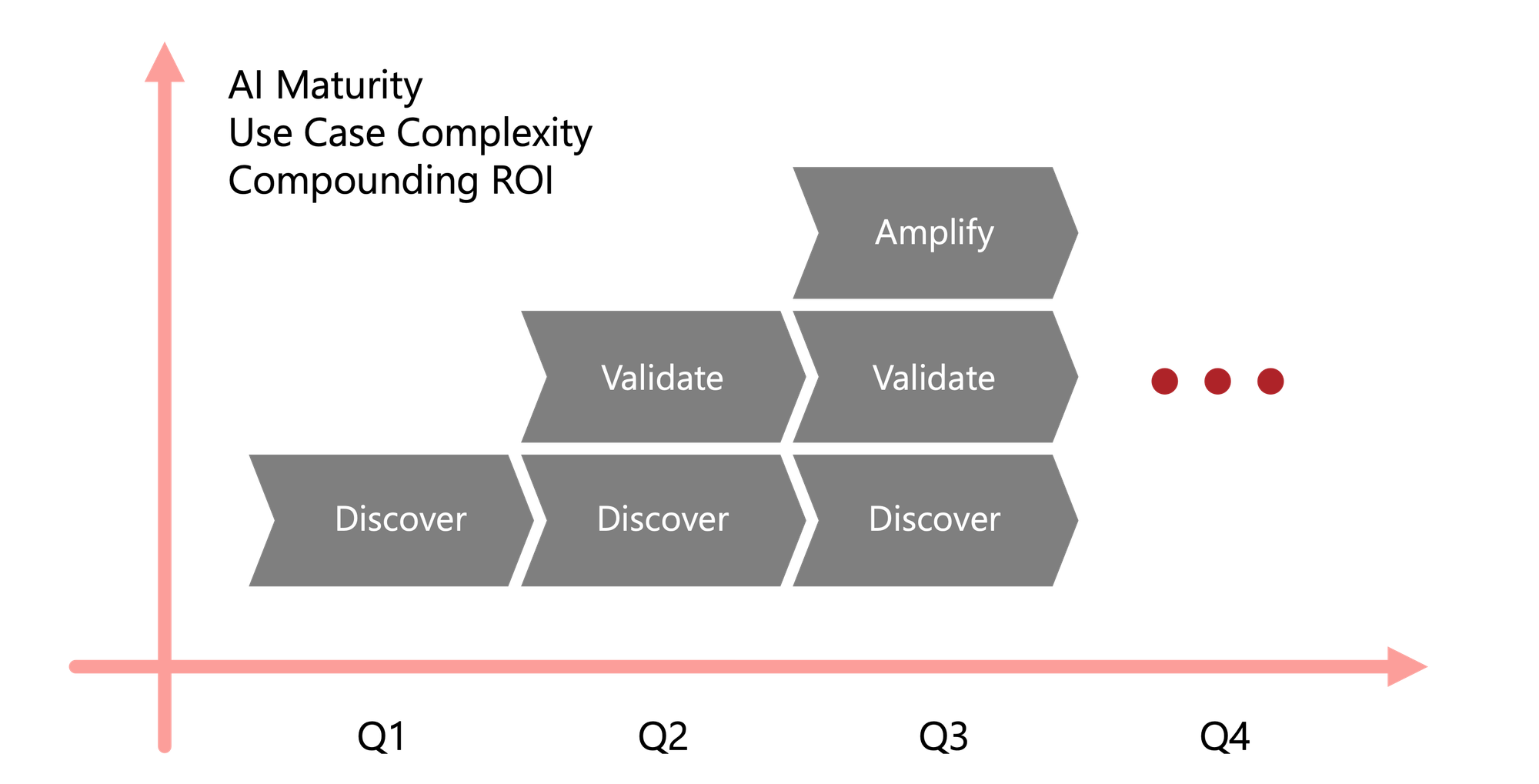
The compounding effect begins here. Organizations that establish a Discover → Validate → Amplify cycle — continuously identifying high-value use cases, testing them, and scaling winners — generate ROI that grows quarter over quarter.
Success at Stage 3 requires more than technology. It demands org design changes (putting the right people in roles that are themselves shifting), governance frameworks, and a no-code or low-code platform capable of deploying production workflows without engineering bottlenecks.
Stage 4 — AI Transformation
AI capabilities become embedded in products and services. The distinction between "AI initiatives" and "the business" disappears. New revenue streams emerge. Business model innovation becomes possible. Competitive advantage is no longer about having access to the same AI tools as rivals — it's about the proprietary workflows, knowledge, and methodologies your organization has encoded into AI systems that competitors cannot replicate.
The question at this stage shifts from "How do we use AI?" to "Where is value moving in our industry, and are we positioned to capture it?" Just as digital photography redefined value from the grain of film to the ease of sharing, generative AI is redefining value from the size of a search index to the quality of a ready answer.
The Strategic Framework: Where + How
Reaching Stages 3 and 4 requires answering two questions simultaneously:

WHERE — Where is value shifting in your industry due to AI? Every major technology transition redistributes value. Leaders who identify the shift early and reposition accordingly build durable advantage. Those who ignore it find that change doesn't ignore them.
HOW — How do you get there? Three levers:
- People – Identify and empower AI champions; redesign roles as the org evolves
- Processes – Build a continuous Discover → Validate → Amplify innovation system that delivers compounding ROI
- Technology – Deploy no-code AI orchestration that lets lean AI teams scale without engineering dependency
The Compounding ROI Imperative
Organizations that implement continuous Discover → Validate → Amplify cycles don't just improve — they accelerate. Each quarter of disciplined use case discovery, validation, and deployment builds on the last. By Q3 and Q4, the gap between these organizations and their Stage 2 peers is not incremental — it's structural.
What Senior Leaders Should Do Now
The maturity model is not a passive map — it's a call to action. Three priorities stand out for enterprise AI leaders:
- Diagnose honestly. Most organizations overestimate their maturity. Audit your current state across people, processes, technology, and information architecture before setting transformation targets.
- Design for the Chasm. The gap between Stage 2 and Stage 3 doesn't close by doing more of the same. It requires a deliberate governance framework, executive commitment, and the right platform to move from chatbots to automated knowledge workflows.
- Measure compounding value. Define success metrics that reward systematic scaling, not just pilot launches. The 95% failure rate is a portfolio problem — organizations that ship too few use cases to production never build the institutional muscle to cross the Chasm.
The organizations that reach Stage 4 won't just be more productive — they will have fundamentally different business models, embedded AI advantages, and new revenue streams that Stage 2 competitors cannot easily replicate.
The AI Chasm is real. Crossing it is a strategic choice.
AI Maturity Diagnostic
Where does your organization stand?
Most leadership teams overestimate their AI maturity — and underestimate how far they are from the Chasm. The AnyQuest AI Maturity Diagnostic takes 10 minutes and scores you across five dimensions: Strategy, People, Processes, Technology, and Measurement.
Know Your Stage
Instant score across five maturity dimensions
Benchmark Your Peers
See how you compare by industry and company size
Get a 90-Day Plan
Suggested actions tailored to your stage and gaps
10 minutes · Instant results · No email required